Speed Distance Time Formula – Essential Calculations Guide
The Fundamental Relationship Between Speed, Distance, and Time
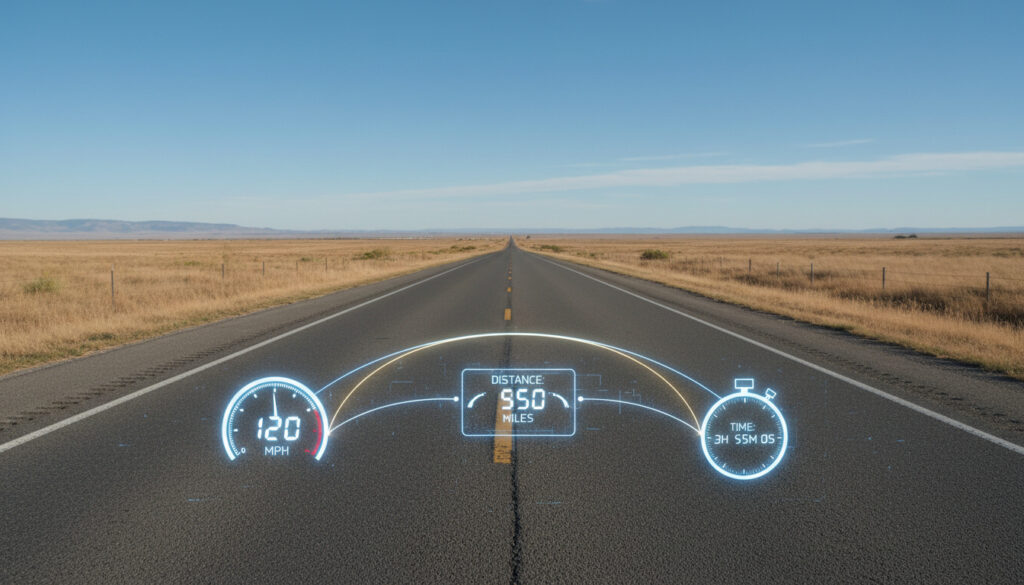
The mathematics of motion rests upon a triangular relationship that has governed transportation since the wheel’s invention. The speed-distance-time formula—commonly expressed as speed equals distance divided by time—provides the computational foundation for modern logistics, sports science, and astrophysics. Whether determining the arrival time of a transatlantic flight or calculating the velocity of tectonic plates, this fundamental equation converts spatial and temporal measurements into actionable velocity data.
Algebraic Variations and Applications
The formula presents itself through three algebraic faces, each serving distinct computational needs. The primary expression calculates velocity by dividing distance traveled by temporal duration. Rearranging the equation yields distance equals speed multiplied by time, essential for mapping projected travel routes. The third permutation—time equals distance divided by speed—allows precise scheduling and resource allocation across industries. These relationships are explored comprehensively in educational resources covering speed calculations, which demonstrate practical applications through interactive examples.
Practical Constraints and Unit Consistency
Real-world applications demand rigorous attention to unit consistency. Aviation navigators convert between knots and kilometers per hour, while astronomers grapple with light-years and astronomical units. The formula assumes uniform motion, creating limitations when applied to acceleration scenarios. As detailed in kinematics tutorials distinguishing speed from velocity, advanced implementations incorporate calculus to handle variable speeds, yet the basic relationship remains indispensable for average velocity calculations across irregular terrain or fluctuating traffic conditions. Engineers frequently reference kinematics basics when applying these principles to structural design.
Comparative Velocity Analysis
| Transport Mode | Typical Speed | Distance Example | Time Required |
|---|---|---|---|
| Human Walking | 5 km/h | 1 kilometer | 12 minutes |
| City Bus | 25 km/h | 10 kilometers | 24 minutes |
| Passenger Train | 120 km/h | 300 kilometers | 2.5 hours |
| Commercial Jet | 900 km/h | 5,000 kilometers | 5.5 hours |
Educational standards emphasize these comparisons, as outlined in secondary physics curricula, ensuring students grasp the magnitude differences between pedestrian pace and supersonic travel.
Dimensional Analysis and Computational Precision
Accurate computation requires dimensional analysis. Metric implementations utilize meters per second or kilometers per hour, maintaining decimal consistency with SI standards. Imperial measurements persist in American and British road systems, employing miles per hour. Conversion factors become crucial when international shipping coordinates between these systems. The formula’s linearity assumes uniform motion; non-constant acceleration requires integration of instantaneous velocity over time intervals. Detailed vector analysis extends these concepts into displacement calculations. Practitioners often consult formula rearrangement techniques to adapt equations for specific computational needs.
Historical Development and Modern Extensions
Ancient Babylonian astronomers first quantified celestial motion using primitive time-distance relationships. Galileo’s inclined plane experiments in the seventeenth century established experimental frameworks for measuring acceleration. The nineteenth-century railway boom necessitated standardized timetables, solidifying the formula’s commercial importance. Space agencies apply these historical principles to modern missions, with educational materials illustrating speed-distance-time relationships through orbital mechanics examples. Twentieth-century relativistic physics complicated the relationship, demonstrating that time itself dilates at velocities approaching light speed, rendering the classical formula valid only within non-relativistic frameworks.
Distinguishing Scalar and Vector Quantities
Common misconceptions confuse speed with velocity. Speed represents scalar magnitude, ignoring directional vectors, whereas velocity incorporates displacement direction. Average speed calculations assume constant rates, potentially masking traffic delays or sprint variations. The formula calculates mean values over intervals, distinct from instantaneous readings provided by speedometers. Understanding these distinctions prevents navigation errors and athletic training miscalculations.
Mathematical Relationships in Economic Contexts
Mathematically, the relationship exhibits hyperbolic contours when plotting speed against time for fixed distances. Economic analyses reveal that reducing travel time by half requires doubling infrastructure investment rather than vehicle capability, following the inverse proportion inherent in the formula. Urban planners utilize these curves to optimize public transit frequencies, balancing operational costs against commuter convenience through the mathematical constraints of distance-time ratios.
Expert Perspectives
The distinction between past, present, and future is only a stubbornly persistent illusion, yet the mathematical relationship between space and time remains absolute within our physical framework.
— Albert Einstein
Operational Significance
The speed-distance-time formula transcends its mathematical simplicity to underpin contemporary civilization’s logistical infrastructure. Mastering its three algebraic permutations enables precise prediction of arrival times, fuel consumption calculations, and athletic performance benchmarks. While relativistic physics modifies these relationships at extreme velocities, classical mechanics’ foundational equation continues guiding daily transportation decisions worldwide.
Frequently Asked Questions
What is the speed distance time formula?
The fundamental equation states that speed equals distance divided by time (s = d/t). This relationship allows calculation of velocity when displacement and duration are known, serving as the basis for kinematics and transportation planning.
How do you rearrange the formula to find distance or time?
To calculate distance traveled, multiply speed by time (d = s × t). To determine duration required, divide distance by speed (t = d/s). These algebraic manipulations maintain the proportional relationships between the three variables.
What units are typically used?
Standard metric units include meters per second (m/s) and kilometers per hour (km/h). Imperial systems utilize miles per hour (mph). Maritime and aviation contexts often employ knots (nautical miles per hour), requiring careful conversion factors between systems.
Does the formula work for accelerating objects?
The basic formula calculates average speed over a time interval. For constantly accelerating objects, such as falling bodies or vehicles changing velocity, physicists apply calculus to integrate instantaneous speeds or utilize kinematic equations that incorporate acceleration variables.
More related posts
 Revlon Hair Dryer Brush – UK Review and Model Guide
 Water Retention in Legs – Causes, Symptoms and Relief
 Skye Nicolson – Biography, Record, and Next Fight
 Is Tomorrow a Bank Holiday – UK 2026 Schedules and Regions
 Mr Motivator – Real Name, Age, Family and 2025 Update
 Legal and General Dividend – Dates, Yield and Growth Guide
 In the Night Garden Toys – Complete Buying Guide for Parents
 Exchange Rate Euro to Pound – Live Rate, Converter & Best Deals Today
