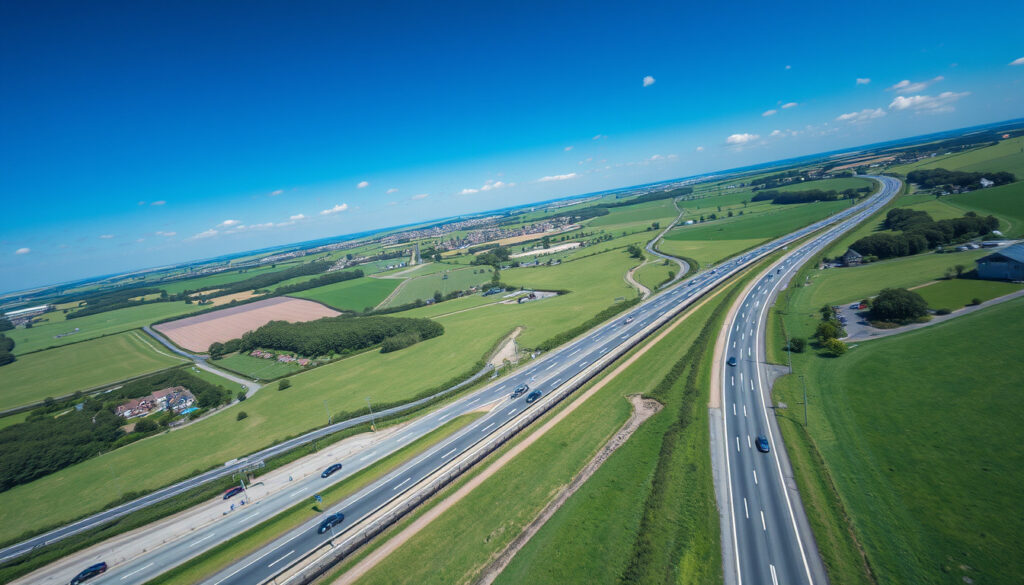
Longest Motorway in UK – M6 Route and Top Rankings
The M6 motorway holds the distinction of being the longest motorway in the United Kingdom, stretching approximately 231 to 236 miles across the country. This significant piece of transport infrastructure connects central England with the Scottish border, passing through multiple major urban centres and serving as a vital artery for both commerce and private travel. Understanding the M6’s role and how it compares to other major routes offers insight into Britain’s motorway network and its historical development.
Britain’s motorway network spans roughly 2,300 miles in total, with the M6 representing its longest continuous stretch. The motorway begins at Junction 19 of the M1 near Catthorpe in Leicestershire and extends northwest to Gretna on the Anglo-Scottish border, where it becomes the A74(M) heading toward Glasgow. This extensive route places the M6 at the heart of England’s north-south connectivity, linking London with Scotland through the industrial heartland of the Midlands and the North.
For travellers and logistics operators alike, the M6 carries substantial traffic volumes, particularly through its busiest sections between junctions 4 and 10a in the West Midlands and junctions 16 to 19 in Cheshire. Both of these stretches have been converted to smart motorways, employing active traffic management to improve flow during peak periods. The scale and importance of this route make it a frequent subject of questions about Britain’s transport infrastructure.
What is the Longest Motorway in the UK?
The M6 motorway stands as the longest motorway in both England and the United Kingdom, covering approximately 231 to 236 miles depending on measurement sources. This figure translates to roughly 370 to 373 kilometres of continuous motorway. The route begins at Catthorpe near Rugby in central England and terminates at the Scottish border near Gretna, where it seamlessly becomes the A74(M) continuing toward Glasgow. The slight variation in reported length across different sources reflects differing measurement methodologies and endpoints used by various authorities.
The M6 length varies slightly between sources, with figures ranging from 231 miles (373 km) to 236 miles (380 km). This discrepancy stems from whether extensions and connector roads are included in the total calculation.
Key Insights on UK Motorways
- The M6 serves as Britain’s motorway “Backbone,” connecting London with Glasgow through England’s industrial heartland.
- Britain’s first motorway section opened on December 5, 1958—the Preston By-pass, later incorporated into the M6.
- The M62 holds the record as the UK’s highest motorway, reaching 1,220 feet above sea level near the Pennine Way footbridge.
- The Bromford Viaduct between junctions 5 and 6 near Birmingham spans 3.5 miles, making it the longest viaduct in Great Britain.
- The M6 passes through nine English counties, linking Coventry, Birmingham, Wolverhampton, Stoke-on-Trent, Preston, Lancaster, and Carlisle.
- Prime Minister Harold Macmillan ceremonially opened the first M6 section, marking a milestone in British road infrastructure.
Snapshot Facts: Top 5 UK Motorways by Length
| Motorway | Length (miles) | Route Summary | Notable Feature |
|---|---|---|---|
| M6 | 232–236 | Catthorpe to Scottish border at Gretna | Longest UK motorway, first opened 1958 |
| M1 | 200 | London to Leeds | Primary south-north connector |
| M4 | 192 | Chiswick, London to Swansea, Wales | Links England with Wales |
| M62 | 107 | Liverpool to Hull | Highest UK motorway |
| M65 | 25.8 | Preston to Burnley and Colne | Links to M6 at Junction 29 |
What are the Top 5 Longest Motorways in the UK?
The ranking of Britain’s longest motorways reveals both the geographic spread of the network and the historical priorities of road planners. While the M6 dominates this list, the other major routes each serve distinct regional purposes and carry significant traffic volumes. Understanding their individual characteristics helps contextualise the M6’s importance within the broader transport infrastructure.
M1 Motorway: The Second Longest
The M1 stands as Britain’s second-longest motorway at approximately 200 miles, connecting London to Leeds via the East Midlands. This route serves as the primary south-north corridor for the eastern portion of England, carrying substantial commuter and freight traffic between the capital and northern cities. The M1 begins at Marble Arch in central London and terminates near Leeds, passing through important urban centres including Nottingham, Sheffield, and Leicester.
Unlike the M6, which traces a path through western England and the industrial Midlands, the M1 provides direct connectivity between London and the major northern population centres. The motorway was opened in stages between 1959 and 1968, reflecting the post-war expansion of Britain’s motorway network. For those interested in calculating journey times along these routes, understanding the distances involved provides useful context.
M4 Motorway: Linking England and Wales
Stretching 192 miles from Chiswick in west London to Swansea in Wales, the M4 holds the distinction of being the longest motorway entirely within England and Wales. This route passes through the economically significant Thames Valley corridor, serving Heathrow Airport, Reading, Bristol, and Cardiff before terminating in Swansea. The M4 forms a crucial component of the east-west transport spine connecting southern England with Wales.
M62: Britain’s Highest Motorway
The M62 spans 107 miles from Liverpool to Hull, crossing the Pennines via a high-altitude route that reaches 1,220 feet near the Pennine Way footbridge. This elevation makes the M62 Britain’s highest motorway, presenting unique engineering challenges during construction and ongoing weather-related considerations for drivers. The route serves as a vital west-east corridor connecting the Port of Liverpool with the Port of Hull, two of Britain’s major maritime gateways.
The M6 intersects with several other significant routes, including the M65 at Junction 29 south of Preston and the M55 at Junction 32 north of Preston, which provides a direct link to Blackpool. These connections enhance the M6’s role as a hub within Britain’s motorway network.
Full List of Motorways in the UK by Length
Beyond the top five, Britain’s motorway network includes numerous shorter but locally significant routes. The full list encompasses motorways of varying lengths, from substantial stretches like the M65 at 25.8 miles to shorter urban motorways serving metropolitan areas. Each contributes to the interconnected nature of road transport in Britain, though none approach the scale of the M6 or M1.
The distinction between motorways and A-roads is important when considering length rankings. While the A1(M) and other A-roads may appear in longer configurations, these are not classified as motorways and therefore fall outside the scope of motorway-specific rankings. The M6 remains the definitive longest motorway designation, with no other UK motorway approaching its approximately 232-mile span.
For those planning travel or studying transport networks, the motorway hierarchy offers different advantages depending on destination. The National Express West Midlands bus routes demonstrate how public transport integrates with the motorway network, particularly in the West Midlands where the M6 sees its heaviest concentrations of traffic between junctions 4 and 10a.
Map of the Longest Motorway in the UK
Visual representations of the M6 route help travellers understand its geographic scope and the regions it traverses. The M6 motorway spans approximately 231 to 236 miles, passing through nine English counties and providing a clear north-south spine through western England. Starting in Leicestershire at the M1 junction near Rugby, the route progresses through Warwickshire, West Midlands, Staffordshire, Cheshire, Greater Manchester, Lancashire, and Cumbria before reaching the Scottish border.
Major urban centres along the route include Coventry, Birmingham, Wolverhampton, Stoke-on-Trent, Preston, Lancaster, and Carlisle. The motorway also provides access between Manchester and Liverpool, two of Britain’s largest cities, serving the M6’s busiest northern sections. Lake District access points near the Carlisle section offer connections to one of Britain’s most celebrated national parks.
The Gretna interchange at the Scottish border marks a transition point where the M6 becomes the A74(M), continuing the route toward Glasgow. This seamless international connection demonstrates how Britain’s motorway network extends beyond political borders, linking England directly with Scotland’s major population centres.
Timeline of the UK’s Longest Motorway
The construction of the M6 spans several decades, reflecting both the ambitious vision and practical constraints of post-war infrastructure development in Britain. Each phase brought new sections into operation, gradually extending the motorway northward and completing gaps in the route.
- December 5, 1958: The 8¼-mile Preston By-pass section opens, becoming Britain’s first motorway. Prime Minister Harold Macmillan performs the ceremonial opening.
- 1960s: Additional sections open progressively, extending the motorway southward from Preston through Lancashire and into Cheshire.
- 1971: The full route from the M1 junction at Rugby to northeast of Birmingham is completed, establishing continuous connectivity from the Midlands northward.
- Early 2000s: Smart motorway conversions begin on the busiest sections between junctions 4 and 10a in the West Midlands and junctions 16 to 19 in Cheshire.
- March 2006: Authorization granted for the extension closing the “Cumberland Gap”—a 6-mile section from Carlisle to the Anglo-Scottish border at Gretna.
- 2008: The final M6 extension to the Scottish border opens, completing the motorway’s full length from Catthorpe to Gretna.
The “Cumberland Gap” closure project addressed a significant discontinuity in the motorway network, connecting Carlisle directly to the Scottish border without requiring traffic to use non-motorway sections of the A74.
Confirmed Lengths and Variations
Different authoritative sources report slightly varying lengths for the M6, reflecting methodological differences rather than factual disagreement. These variations are normal in infrastructure documentation and do not indicate uncertainty about the motorway’s significance or scale.
| Source | Reported Length | Notes |
|---|---|---|
| Wikipedia (M6 motorway) | 236 miles (380 km) | Comprehensive measurement including all sections |
| ICE (Institution of Civil Engineers) | 231 miles (373 km) | Standard reference length |
| Various transport sources | 232–236 miles | Range reflecting measurement differences |
It is worth noting that the A1 road—Britain’s longest road—is longer than any motorway but does not qualify as a motorway due to its mixed classification and access characteristics. For comparison purposes, motorway rankings consider only roads bearing the M designation, placing the M6 firmly at the top despite the A1’s greater total length as a numbered route.
Context: UK Motorway Network Overview
Britain’s motorway network comprises approximately 2,300 miles of high-speed dual carriageway designed for long-distance and inter-urban travel. The network grew primarily during the 1960s and 1970s, with the M6’s Preston By-pass pioneering the concept of controlled-access high-speed roads in 1958. The “Backbone” concept—linking London with Glasgow through England’s industrial regions—defined much of the network’s development strategy.
The M6’s economic significance extends beyond its role as a transport artery. It connects major industrial centres including the Birmingham and Wolverhampton conurbation, the Potteries area around Stoke-on-Trent, and the port city of Preston. Freight traffic constitutes a substantial portion of the motorway’s use, with the route serving as a primary corridor between manufacturing centres in the Midlands and distribution networks reaching Scotland.
Environmental and community considerations have influenced motorway development throughout its history. The Bromford Viaduct, spanning 3.5 miles between Birmingham junctions 5 and 6, represents one of the most ambitious engineering solutions to these constraints, elevating the motorway above difficult terrain while maintaining connectivity with surrounding communities.
Sources and Key Quotes
The M6 motorway is the longest motorway in the United Kingdom, running for approximately 230 miles from the M1 at Catthorpe near Rugby to the A74(M) at the Scottish border near Gretna.
At 231 miles, the M6 is the United Kingdom’s longest motorway, running from Catthorpe in the south to the Scottish border near Gretna.
The M6 was the first motorway to be built in Britain, with the Preston By-pass opening in December 1958.
Related Topics
For readers seeking to expand their understanding of Britain’s transport infrastructure, several related topics offer valuable context. The M6’s interaction with other major routes, including the M1, M4, and M62, creates a network where understanding individual components enhances appreciation of the whole system.
Journey planning along the M6 and other major routes often involves considerations of speed limits, average traffic speeds, and the speed distance time formula for estimating travel durations. The 70 mph national speed limit applies to motorways, though smart motorway sections may feature variable speed limits during periods of high congestion.
Frequently Asked Questions
What is the longest motorway in the world?
The Pan-American Highway holds the record for the world’s longest road system, stretching approximately 19,000 miles from Alaska to Argentina. Among individual motorways, China’s G30 highway exceeds 9,000 miles, while the M6’s 232-mile span, while Britain’s longest, represents a relatively modest distance by global standards.
Is the A1 a motorway?
The A1 is Britain’s longest numbered road, but it is not classified as a motorway. While sections of the A1 have been upgraded to motorway standard and designated A1(M), the route as a whole includes non-motorway sections with roundabouts, side roads, and direct property access.
What is the national speed limit on UK motorways?
The national speed limit on UK motorways is 70 mph for cars and light vehicles. Lower limits apply to heavy goods vehicles and other restricted vehicles. Smart motorway sections may impose variable speed limits during congestion or incidents.
How long does it take to travel the full M6?
At motorway speeds approaching the 70 mph limit, traversing the M6’s approximately 232-mile span would theoretically take around 3 hours and 20 minutes without stops or traffic delays. Actual journey times vary significantly based on traffic conditions, particularly through busy sections around Birmingham and Manchester.
What is Britain’s highest motorway?
The M62 holds the distinction of being Britain’s highest motorway, reaching an elevation of 1,220 feet above sea level near the Pennine Way footbridge. This high-altitude section crosses the Pennines between Manchester and Leeds.
When was the M6 fully completed?
The M6 reached its full length with the opening of the Gretna extension in 2008, which closed the final gap between Carlisle and the Scottish border. The original Preston By-pass opened in 1958, with most of the intervening sections completed by the 1970s.
What is the longest viaduct on the M6?
The Bromford Viaduct between junctions 5 and 6 near Birmingham is the longest viaduct in Great Britain, spanning 3.5 miles. This elevated section carries the motorway over difficult terrain and connects the West Midlands urban area.
Does the M6 connect to Scotland?
The M6 terminates at the Anglo-Scottish border near Gretna, where it becomes the A74(M) motorway. This continuation provides direct motorway connectivity from England through to Glasgow, creating a seamless north-south route across the border.
More related posts
 Wicked Little Letters Cast – Full List, True Story and Viewing Guide
 Phil Hartman – How He Died, His Family, and Iconic Roles
 Brianne Howey Movies and TV Shows – Complete Filmography
 Anthony Scaramucci – Biography, Net Worth and 11-Day White House Tenure
 Mr Motivator – Real Name, Age, Family and 2025 Update
 Cruises from Southampton 2024 – Top Lines, Deals & Itineraries
 South Africa Women vs England Women – 125-Run Semi-Final Win
